

What Is IRMAA?
IRMAA is one of those things that can catch people off guard in retirement.
It’s an additional premium added to Medicare Part B and Part D when your Modified Adjusted Gross Income (MAGI) exceeds certain thresholds. What makes it tricky is the timing. IRMAA is based on your income from two years prior, not what you’re earning today.
So, if you had a higher-income year, maybe from selling a property or completing a large Roth conversion, you could see your Medicare premiums increase down the road. And once triggered, that higher premium applies for the entire year.
IRMAA Thresholds
For 2026, the first threshold begins at $109,000 for individuals and $218,000 for married couples filing jointly. From there, there are multiple tiers.
For example, Medicare Part B:
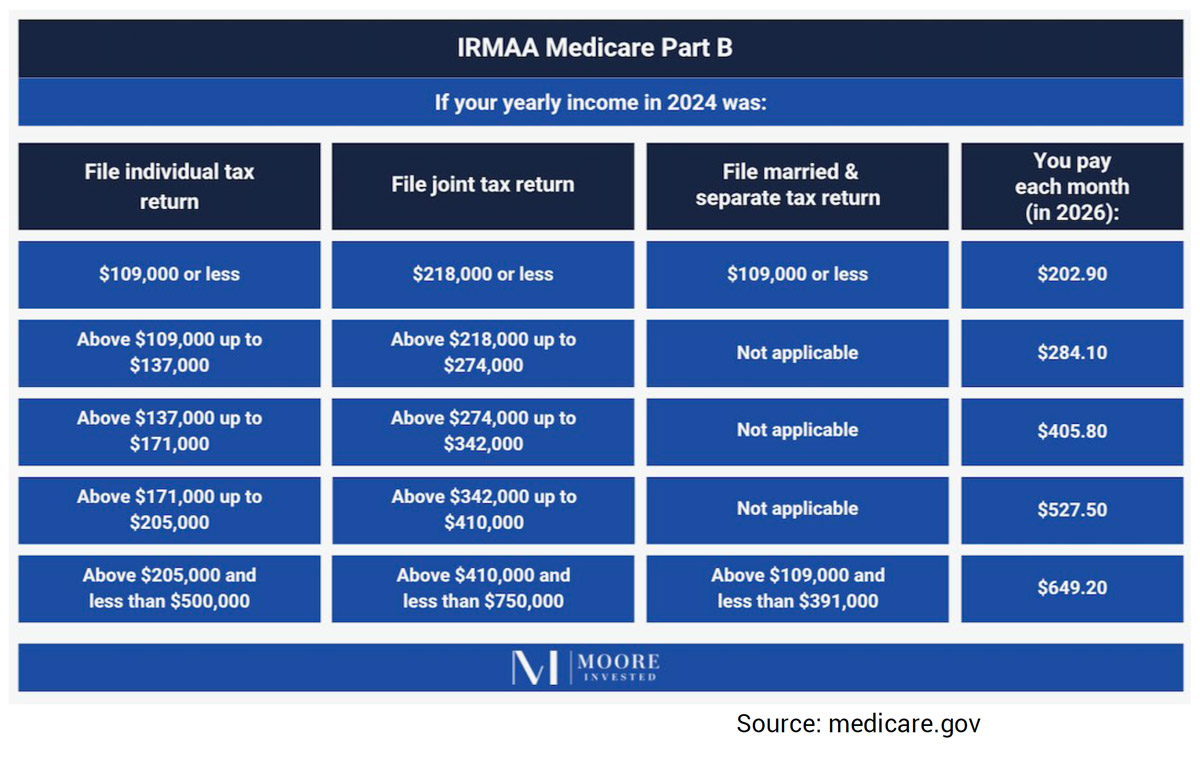
The key point here is that IRMAA works in steps. Even a small increase in income can push you into the next bracket, which means higher premiums across the board, not just on the portion above the threshold.
How to Think About Managing IRMAA
We can’t predict exactly where thresholds will be in the future. But we can control how income shows up on your tax return.
That starts with understanding where your income is coming from: social security, pensions, retirement accounts, and investments, and then being intentional about timing.
A few strategies we often look at:
- Strategic withdrawals: Retirees with multiple accounts can withdraw funds across accounts so that no single account exceeds the threshold. If you don’t have to make withdrawals from tax-deferred accounts, withdraw from tax-free accounts like a Roth IRA.
- Roth conversions: When you turn 73, the IRS requires you to take required minimum distributions (RMDs) from tax-deferred retirement accounts, such as Individual Retirement Accounts and 401(k)s. This raises your taxable income every year. Converting these accounts to a Roth account lets you avoid required withdrawals. However, keep in mind that Roth conversions mean paying a large amount of income tax that year to avoid taxes in the future.
- Managing Capital Gains: When you sell an investment at a profit, your MAGI increases. To reduce the likelihood of hitting an IRMAA threshold, space out your asset sales over multiple years to keep taxable income manageable.
- Qualified Charitable Distributions (QCDs): A Roth conversion isn’t the only way to avoid taking RMDs from your tax-deferred accounts. Making QCDs directly from your IRA to a registered charity counts toward your RMD, but it doesn’t reduce your taxes.
The Bigger Picture
IRMAA isn’t something you can always avoid, and that’s okay. The goal isn’t perfection. It’s awareness and coordination.
When income is planned with intention, you can reduce surprises and keep more control over your long-term costs. That’s where thoughtful planning makes a difference, not just in minimizing taxes, but in creating a more predictable retirement.
At the end of the day, it’s not just about avoiding higher premiums, it’s about building a plan that gives you confidence, flexibility, and the ability to live life with an upside.

Our mailing address is:
2 Ravinia Drive, NE Suite 1705 Atlanta, GA 30319 (404) 905-2290