

The housing market and its corresponding stocks have had a rough time over the last two years. Homebuilding equities fell substantially because high interest rates and low affordability cooled a once red-hot housing market. Meanwhile, the broader stock market indices kept going up.
That difference has led to a situation where housing fundamentals and sentiment are no longer in sync. Recent figures show that the housing market is stabilizing and, in some places, improving. Although, no one has the proverbial crystal ball, the current situation reminds us of good entry points of the past.
Market Signs That Housing Has Hit Bottom
Ned Davis Research has a treasure trove of housing data and sales of new homes are starting to go up again. On a seasonally adjusted annualized basis, sales in October were almost 737,000 units, which is roughly 19% more than the same month the year prior. Sales have stayed above 710,000 units for three months in a row, which hasn’t happened since early 2022. Demand is no longer going down.
Mortgage demand is also starting to stabilize. The MBA purchasing index fell to a historic low in late 2023, but it has since made a big comeback. It is currently up more than 30% from its lowest point, suggesting that the worst of the affordability shock is over.
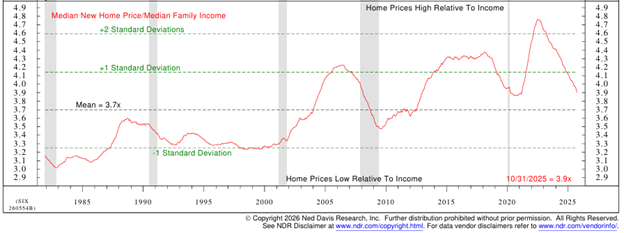
New-Home Affordability Is Improving
The median price of a new home is now roughly 3.9 times the typical household income, which is close to the long-term average of 3.7 times. That percentage is the same as immediately before the housing boom caused by the pandemic.
This improvement mostly affects new homes, not existing ones, where prices are still high. That difference helps homebuilding stocks because they can offer incentives and control supply. The resale market takes longer to respond than builders, and this responsiveness usually shows up first in their earnings and share prices.
Valuations in Historical Context
Prices for homebuilding stocks are fair compared to what they have been in the past. Price-to-book multiples sit at 1.8, close to their long-term averages. Even though the prices aren’t at a bottom, they could go up if conditions stay stable. The 2024 peak was a 2.4 price/book multiple, a 33% valuation upside from here.
Looking at the markets as a whole, real estate as an asset class is trading at one of its lowest relative valuations compared to the stock market in decades. The total value of homes is now slightly over half the value of stocks in the U.S. This is the lowest ratio since the 1950s. In the past, real assets have done well during market rotations like this one.
Consumer Sentiment Remains Negative
In the past, negative consumer sentiment has created a good situation for homebuilders. When sentiment drops dramatically from one year to the next, homebuilding companies tend to do better than the market as a whole in the following year.
Homebuilders’ average performance relative to the S&P 500 over the next 14 months is about a 33% return. Even while results will never be exactly what they were in the past, that historical pattern is positive.
Risk and Positioning
There is always some risk in the industry. There are still a lot of homes for sale, and profits could dry up if demand drops again. Seasonal changes also have a role; late winter is usually a bad time for homebuilding stocks.
Yes, homebuilders have faced a lot of negative news since the pandemic. Now, interest rates are trending lower, sales trends are getting better and valuations are fair. Couple that with the fact that consumer sentiment is still pretty negative. In the past, those situations have proved to be good entry points.

Our mailing address is:
2 Ravinia Drive, NE Suite 1705
Atlanta, GA 30319
(404) 905-2290