

Historically, midterm election years have followed a familiar pattern: investor sentiment becomes increasingly pessimistic, often creating conditions for a market rally as Election Day approaches. With the 2026 midterm elections nearing, the question is whether sentiment has reached the levels typically associated with that opportunity.
Ned Davis Research (NDR) provides a useful perspective through its Daily Trading Sentiment Composite, which measures prevailing investor sentiment. This year, the composite fell to approximately 30 in September, reflecting a notable increase in pessimism.
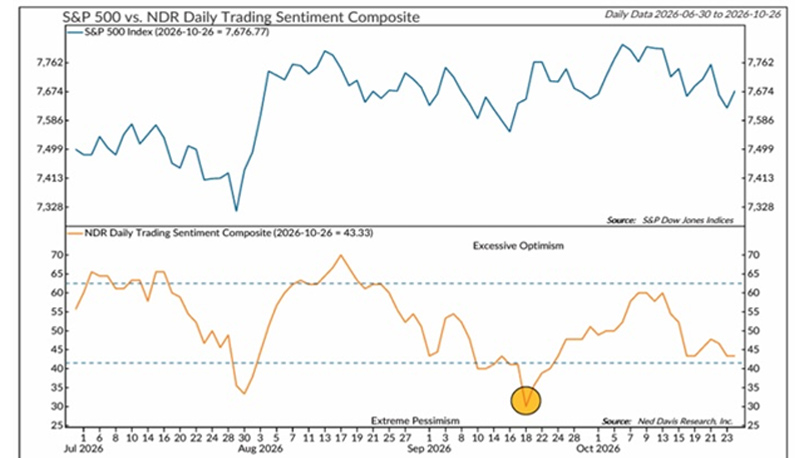
Although sentiment has weakened, this year’s low remains considerably higher than the levels recorded during most previous midterm election periods. To understand why that distinction matters, it helps to examine the historical relationship between investor sentiment and market performance. Across the 11 previous midterm election periods shown below, the average sentiment low was 15.7, with a median of 15.4. The 2026 reading of approximately 30 is the second-highest low among those periods. This suggests that investors have not yet reached the degree of pessimism that typically characterized these historical lows.

The market’s historical performance adds another dimension to this comparison. Across those 11 periods, the S&P 500 gained an average of 16.9% from its low to its subsequent high, while the median gain was 14.1%. These results illustrate a recurring pattern in which substantial market advances have often followed periods of pronounced pessimism.
What does this mean for investors?
Before looking at this data, it would be hard to believe that investors are not “negative” enough this election cycle. Anecdotally, we see negativity everywhere. Most normal people think “it has never been this bad,” but based on this data that is not the case. In fact, saying this another way, investors are less negative than they have been in 10 of the last 11 midterm elections.
It is still very likely that we will have a midterm rally, but the size and scope could be limited this year because we are beginning from a more optimistic starting point. Rather than treating the midterm rally as a foregone conclusion, investors should consider sentiment alongside economic conditions, corporate earnings, interest rates, and other fundamental factors. Historical patterns can help frame expectations, but a disciplined investment strategy should account for what the market is telling us today, not just what it has done in the past.

Moore Invested Disclosure
Advisory Services offered by Arkadios Wealth. Moore Invested and Arkadios are not affiliated through any ownership.
This article contains forward-looking statements based on historical market observations and current conditions. Forward-looking statements are inherently uncertain, and actual market results may differ materially from those discussed. Past performance does not guarantee nor is indicative of future results. This summary of statistics, price, and quotes has been obtained from sources believed to be reliable but is not necessarily complete and cannot be guaranteed. All securities may lose value, may not be insured by any federal agency and are subject to availability and price changes. Market risk is a consideration if sold prior to maturity. Information and opinions herein are for general informational use only and subject to change without notice.
Our mailing address is:
2 Ravinia Drive, NE Suite 1705
Atlanta, GA 30319
(404) 905-2290